

D41000
D-series Quad Power Amplifiers
172.149UK
Introduction
Thank you for choosing the D-series quad amplifier as part of your sound equipment. Thisfour channel amplifier delivers efficient, high power audio for professional sound reinforcement applications. Please read this manual in full and follow the instructions to gain the best results from your D-series amplifier.

Warning
- To prevent the risk of fire or electric shock, do not expose any of the components to rain or moisture.
- If liquids are spilled on any component, stop using immediately, allow unit to dry out and have checked by qualified personnel before further use.
- Do not allow ingress of dust or foreign objects into any apertures on the housing and prevent blocking of the cooling vents.
- Avoid impact or heavy vibration to any of the components.
- No user serviceable parts inside the amplifier housing.
- Refer servicing to qualified service personnel.
Safety
- Connect only to a suitable mains power outlet using the power lead provided or an approved equivalent lead.
Placement
- Keep the unit away from moisture or dusty environments.
- Do not place heavy objects on top of the unit
Cleaning
- Disconnect from power before cleaning the unit.
- Use a soft dry or slightly damp cloth to clean the surfaces as required.
- A soft brush can be used to clear debris from the unit without damaging it.
- A vacuum cleaner may be used to remove debris from the cooling vents.
- Do not use solvents for cleaning the product.
Front panel
 ]()
]()
- CH1 indicators (PROTECT, CLIP, SIGNAL, POWER)
- CH2 indicators (PROTECT, CLIP, SIGNAL, POWER)
- CH3 indicators (PROTECT, CLIP, SIGNAL, POWER)
- CH4 indicators (PROTECT, CLIP, SIGNAL, POWER)
- CH1 output level control
- CH2 output level control
- CH3 output level control
- CH4 output level control
- Power on/off switch
Rear panel (D41000 shown)

- 20mm mains fuse holder
- CH3+4 high pass filter (120Hz HPF) on/off switch
- CH3+4 mode switch - Bridge - Stereo - Parallel
- CH1 low pass filter (120Hz LPF) on/off switch
- CH1+2 mode switch - Bridge - Stereo - Parallel
- Mains power inlet (Powercon or IEC)
- Cooling fan - do not cover
- CH4 speaker output
- CH3 speaker output
- CH2 speaker output
- CH1 speaker output
- CH4 line input XLR
- CH3 line input XLR
- CH2 line input XLR
- CH1 line input XLR
- Cooling fan - do not cover
Power requirements
- Power supply: mains 100-240Vac, 50/60 Hz
- Use the provided power lead or approved equivalent.
Installation
- Unpack the unit and verify that the D-series amplifier is intact and supplied with the appropriate power lead(s)
- The amplifier is built into a standard 19" 1U housing, which can be mounted into a standard rack cabinet or case.
- Ensure that excessively heavy items are not situated on top of the amplifier
- Do not cover cooling vents and allow adequate space for airflow
- Do not cover the front vents.
- Ensure easy access to cables and connections at the rear.
Setting Up
Connect speaker cabinets to outputs 1, 2, 3, and 4 using good quality Speakon® leads (15).
Ensure the combined load on each channel is no lower than 4Ω.
Speaker Load Notes
Most PA speakers have a nominal impedance of 8Ω.
- One 8Ω speaker per output = OK
- Two 8Ω speakers wired in parallel (+ to + and − to −) = 4Ω load
- If a speaker has 2 input connectors that are wired in parallel, connecting one of these to another speaker means they are connected in parallel.
- Never connect 2 amplifiers to a single passive speaker.
Ensure that speakers can handle the power delivered at the rated (or combined) load impedance.
Amplifier Modes
Each pair of channels has a MODE switch (12, 14).
Stereo Mode
This is the default mode.
Each input feeds its corresponding output:
- IN1 → OUT1
- IN2 → OUT2
- IN3 → OUT3
- IN4 → OUT4
Parallel Mode
In Parallel mode, each pair of inputs is summed to mono.
- OUT1+OUT2 receive a mono mix of inputs IN1 and IN2.
- OUT3+OUT4 receive a mono mix of inputs IN3 and IN4.
Bridge Mode
Bridge mode combines two amplifier channels into one higher-power output.
Input connections:
- IN1 for CH1+CH2 bridge
- IN3 for CH3+CH4 bridge
Output connections:
- Speaker connected to OUT1 (CH1+CH2 bridge)
- Speaker connected to OUT3 (CH3+CH4 bridge)
Speakon wiring:
- Pin 1+ = +
- Pin 2+ = -
WARNING: Minimum load in Bridge Mode is 8Ω.
Built-In Filters
The D-Series includes switchable crossover filters (11, 13)
CH1 Low Pass Filter (LPF)
- 120Hz Low Pass Filter
- Designed for subwoofers
- Can be combined with Bridge or Parallel mode
Only IN1 input includes LPF because sub-bass performs best in mono.
Channels C+D High Pass Filter (HPF)
- 120Hz High Pass Filter
- Switchable for both channels together
- Intended for mid/high cabinets
Example 2.1 Bi-Amp System
- Channels 1+2 bridged into one 8Ω subwoofer using LPF
- Channels 3+4 in stereo using HPF
- Drives two mid-top cabinets
Input Connections
Connect mixer or line-level outputs to rear-panel XLR inputs IN1 / IN2 / IN3 / IN4

Balanced Wiring
| Function | Pin |
|---|---|
| Signal Hot (+) | 2 |
| Signal Cold (-) | 3 |
| Ground | 1 |
Unbalanced Wiring
| Function | Pin |
|---|---|
| Signal Hot (+) | 2 |
| Ground | 1 + 3 |
Powering Up
- Connect mains supply to the power inlet (15).
- Ensure IEC lead is earthed and secure.
- Turn all channel controls fully down.
- Press power switch (1).
The amplifier uses a soft-start circuit and may take a few seconds before becoming operational.
Setting Levels
- Keep mixer output low.
- Increase amplifier channel levels to desired setting (typically full).
- Gradually raise mixer output until sound is heard.
- Continue increasing to the required operating level.
LED Indicators
Each channel has LED indicators as follows:
- POWER: indicates that power is on to that amp channel
- SIGNAL lights when a signal is present
- CLIP should only light momentarily during brief peaks in the audio
- PROTECT this lights when a fault has occurred and the amplifier is protecting itself.
#### Note: if the CLIP LED lights more than a very brief moment on the loudest peaks, reduce the input gain or out level
If the PROTECT LED lights:
- Turn all channel levels down.
- Switch amplifier off.
- Restart amplifier.
If protection remains active:
- Refer servicing to a qualified technician.
Powering Down
Before switching off:
- Reduce all channel levels to minimum.
- Then power off.
This prevents loud pops or transients that may damage connected speakers.
Troubleshooting
| Problem | Solution |
|---|---|
| POWER LED not lit | Check power connection and mains outlet |
| POWER LED on but no output | Check signal source and gain controls |
| SIGNAL LEDs active but no output | Check speakers and speaker leads |
| AUDIO PROTECT or POWER PROTECT lit | Disconnect mains, check speakers, restart |
| Still in Protect Mode | Refer to qualified service personnel |
| Distorted output and LIMIT LEDs active | Check impedance, reduce input level |
| Very low output | Verify line-level source and increase gain |
Disposal
The Crossed Wheelie Bin symbol indicates that this product is classified as Electrical or Electronic Equipment (EEE).
Do not dispose of with household or commercial waste.
Dispose of the product according to local council recycling and waste disposal regulations.
Specification
| Specification | Value |
|---|---|
| Weight | 6.400kg |
| Dimensions | 482 x 320 x 44mm (without feet) |
| Bridge power @ 8 Ohms | 2 x 1800W (both pairs of channels bridged) |
| Output : rms @ 8 Ohms | 4 x 600W |
| Output : rms @ 4 Ohms | 4 x 1000W |
| Power supply | 100-240Vac, 50/60Hz (Powercon) |
| Power supply | 220-240Vac, 50/60Hz (IEC) |
| Modes | 2 x Stereo, Parallel (mono), Bridge (mono) |
| Input sensitivity | 0dB = 0.775Vrms |
| Crossover | Input A 120Hz LPF and C+D 120Hz HPF (all switchable) |
| Input connections | 4 x XLR female |
| Sound output | 4 x SPK connectors |
Precautions
 |
CAUTION |  |
| RISK OF ELECTRIC SHOCK DO NOT OPEN | ||
| CAUTION : TO REDUCE THE RISK OF ELECTRIC SHOCK, DO NOT REMOVE COVER (OR BACK) NO USER-SERVICEABLE PARTS INSIDE REFER SERVICING TO QUALIFIED SERVICE PERSONNEL | ||
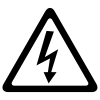
This symbol indicates that dangerous voltage constituting a risk of electric shock is present within this unit
This symbol indicates that there are important operating and maintenance instructions in the literature accompanying this unit
Safety Notice
- Prior to use, read through this safety guide.
- Pay attention to safety warnings.
- Observe all operating requirements.
- For any items designed for indoor use only, do not operate near water or in humid environments.
- For cleaning, only use a lint-free, dry cloth.
- Install according to the specifications.
- Place away from heat sources or heating appliances.
- During placement, ensure adequate support for the product and access to controls and connectors.
- Do not obstruct any cooling vents or openings and allow adequate space for air flow.
- Use only power connections supplied with the product or suitable equivalents.
- Do not modify the equipment in any way.
- For any mains powered appliances, ensure that the mains voltage is as described in the specifications.
- Keep powered products and batteries away from the reach of children.
- In case of malfunction, water ingress or other damage, consult qualified service personnel.
- Avoid pressure or impact to the housing that may result in damage when transporting or installing this product.
- For any Earthed mains product, ensure that the power supply has a protective Earth connection.
- Keep all packaging materials out of reach of children.

Disposal : The "Crossed Wheelie Bin" symbol on the product means that the product is classed as Electrical or Electronic equipment and should not be disposed with other household or commercial waste at the end of its useful life. The goods must be disposed of according to your local council guidelines.

AVSL Group Ltd, Unit 2 Bridgewater Park, Taylor Road, Manchester, M41 7JQ, Unitied Kingdom

AVSL (EUROPE) Ltd, Unit 3D North Point House, North Point Business Park, New Mallow Road, Cork, Ireland


